 屬靈共同書目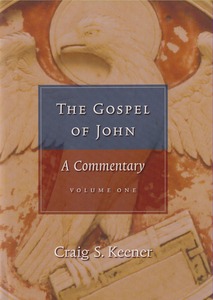
內容簡介
Keeners commentary explores the Jewish and Greco-Roman settings of John more deeply than previous works, paying special attention to social-historical and rhetorical features of the Gospel. It cites about 4,000 different secondary sources and uses over 20,000 references from ancient literature.
"Sixteen hundred pages is a lot of pages for a commentary on the Gospel of John, surpassing Raymond Brown and almost matching Rudolf Schnackenburgs three volumes. But Craig Keener has given us far more than a commentary. He has invited us into the world of that Gospel and made it a magnificent window into the thought and practice of early Judaism and, to a lesser extent, the whole Greco-Roman world of the first century. At the same time, he has made those first-century worlds a lens through which to view the Gospel of John itself. The reader will find this work a treasure trove of information about the origins of Christianity, shedding light on such questions as what is a Gospel? how reliable are the four Gospels in their portrayal of Jesus of Nazareth? and in particular how reliable is the Gospel of John? Keener presents a compelling case for viewing Jesus himself within the framework of early Judaism, and for both the Jewishness and the essential reliability of the traditions about Jesus preserved in Johns Gospel. Keeners introduction runs to well over three hundred pages, and his bibliography to almost two hundred.
Review:
"If you are looking for a good all-rounder, [with] serious scholarship without forfeiting readability, then this is worth the investment." -- Regent s Reviews, Spring 2004
"Keener s commentary is set to make a major contribution to the field for years to come." -- Journal of the Evangelical Theological Society, June 2004
"This is a serious commentary that will also serve as a rich bibliographical resource." -- The Bible Today, May/June 2004
From the Inside Flap:
"Keener s commentary is marked by intelligence as well as comprehensiveness. In the marshalling of relevant materials from John s own milieu and in the canvassing of modern scholarly literature, Keener is unsurpassed in his generation of Johannine scholars. . . . Serious interpreters of the Gospel of John will not always agree with Keener s conclusions, but they must take account of his work."--D. Moody Smith Jr., George Washington Ivey Professor of New Testament, Duke University, past President of Society of Biblical Literature
"With his comprehensive treatment of the relevant ancient literature Keener plants the Fourth Gospel deep in the soil of its time and place. The author s meticulous and encyclopedic documentation of both ancient and contemporary literature makes this a commentary of supreme importance for any who wish to crack the Johannine puzzle. You may not always agree with Keener, but I am confident you will admire and learn from his careful scholarship."--Robert Kysar, Emeritus Bandy Professor of Preaching and New Testament, Candler School of Theology, Emory University
"Keener s detailed knowledge of the ancient sources is enviable. He provides a wealth of documentation on the ancient Mediterranean cultural, social, political, religious, and literary milieu of the Fourth Gospel. On numerous occasions his discussion of Jewish and Greco-Roman cultural conventions aids appreciation of the details of John s narrative. His commentary is therefore a mine of illuminating background material for all students of this Gospel. Its social-historical focus makes it an excellent complement to those commentaries which concentrate more on literary and theological matters."--Andrew Lincoln, Portland Chair in New Testament Studies, University of Gloucestershire, England
"This exhaustive commentary on the Gospel of John is an example of evangelical scholarship at its best. Keener relentlessly pursues all the possible sources for the Johannine story. The historical Jesus, early Christian tradition, Palestinian, rabbinic, and the Mediterranean worlds are his regular points of extensive reference. Keener s reading of the Fourth Gospel as a story written for a rejected Jewish community, claiming they are the true Israel, and that Jesus is the perfection of the gift of Torah, raises questions that must be taken into account by future Johannine scholarship."--Francis J. Moloney, SDB, Katharine Drexel Professor of Religious Studies, The Catholic University of America, past President of Catholic Biblical Association.
延伸連結
版本資訊
- Hendrickson・2003-01-01・1636 頁ISBN13 9781565633780、STORE 1565633784print HKD 720