 屬靈共同書目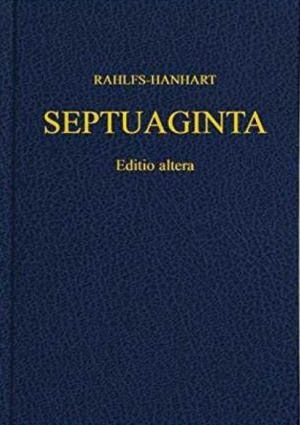
內容簡介
Septuagint = "Rahlfs-Hanhart"! The world-renowned Septuagint edition by Alfred Rahlfs, proven for decades, is now available in a new, improved and updated edition, edited by Robert Hanhart.
Since its publication in 1935, Alfred Rahlfs' Septuagint edition has been a crucial foundation for Septuagint research worldwide. To ensure this remains the case, the internationally renowned Septuagint scholar Robert Hanhart has revised the Rahlfs Septuagint edition published by the German Bible Society. In this revision, the Greek biblical text and the critical apparatus were corrected and supplemented in well over a thousand places. The resulting "editio altera" is now the definitive and affordable Septuagint edition. This edition of the Septuagint (LXX) sets new standards for scholarly study of the Greek Old Testament!
The Septuagint standard work as a reduced edition in Ancient Greek with introductory texts in German, English and Latin
*******************************************
Alfred Rahlfs's edition of the Septuagint has been a major foundation for research worldwide since its initial publication in 1935. Subsequently, in 2006, Rahlfs's edition was revised by the renowned scholar Robert Hanhart, who corrected and expanded the text and apparatus in over a thousand instances.
Although it evolved gradually, the Septuagint does not rely solely on the existing Hebrew portion of the Holy Scriptures as we know them, since the list of Hebrew scriptures only acquired a definitive form in the 3rd/2nd centuries BCE, and even later the section not contained in the Pentateuch and the Prophets. Thus, the Hebrew Bible and the Septuagint developed in parallel through a complex process. As a comparison of the Greek and Hebrew textual recensions demonstrates, the Septuagint is based on an independent Hebrew text, in some parts even older than the one that would later acquire canonical validity among the Jewish people. For the New Testament, the Septuagint—like the collection of the Holy Scriptures—is at least as important as the Hebrew text. For the early Greek-speaking Christians, the Septuagint was Holy Scripture, and indeed, the New Testament authors based their quotations from the Old Testament more on the Septuagint than on the Hebrew (and Aramaic) text.
During the course of the separation of the paths of Christianity and Judaism, the Septuagint became established as the Holy Scripture of the Church. In fact, some translators, such as Aquila and Theodotion, endeavored to produce a Greek translation for Judaism in the second century. However, over time, Jewish rabbis felt an ever-increasing aversion to a Greek translation of the Torah. On the other hand, within the Church only a few scholars (Origen, Jerome) remained familiar with reading the Hebrew text, which, in fact, had fallen out of use in the practice of Western churches. It was the humanists of the early 16th century who revived it for Western Christianity, especially for the churches of the Reformation. For Eastern and Byzantine Christianity, the Septuagint continues to be the definitive text of the Old Testament.
Publisher's Synopsis
This is a new 2nd Revised Edition. The manual edition of the Septuagint by Alfred Rahlfs has been the standard critical edition of the Greek Old Testament for decades. It is now available in this 2nd revised edition, edited by Robert Hanhart in 2006. English, German, Latin and Modern Greek introductions. Key to Sigla
Size: 5.31 x 2.09 x 7.6 inches
Binding: Sewn cardboard cover stamped in gold
延伸連結
版本資訊
- Robert Hanhart (eds.)・2006-01-01・1015 頁ISBN10 3438051192、ISBN13 9783438051196、STORE 9783438051196print HKD 799